← Agricultural Valleys | Country Towns →
… according to the pattern 03-city-country-fingers, there is a rather sharp division between city land and rural land. But at the ends of city fingers, where the country fingers open out, there is a need for an additional kind of structure. This structure has traditionally been the suburbs. But…
Notes
This will be another smaller set of pattern notes, I think. The pattern itself is not very long, but the authors nonetheless throw down a gauntlet off-the-bat in this one:
The suburb is an obsolete and contradictory form of human settlement.
Woof! Recalling from my last read-through of this book, this will be the first time this sentiment comes up. I’m still forming an opinion on it, myself — especially in relation to The Neighborhood and looking at this text through the lens of graph theory, but it is worth noting the principal here.
Their proposition is, rather than suburbs, to break up much of the immediate outer edges of cities into 1-square-mile blocks, each with 400 households around the edge of the block (100 per edge) and conserving the inner land for farms or conservation.
Visualizing this with (yet another) poor overlay — this is the rough scale of 1-square-mile grids overlaid over Salt Lake City:
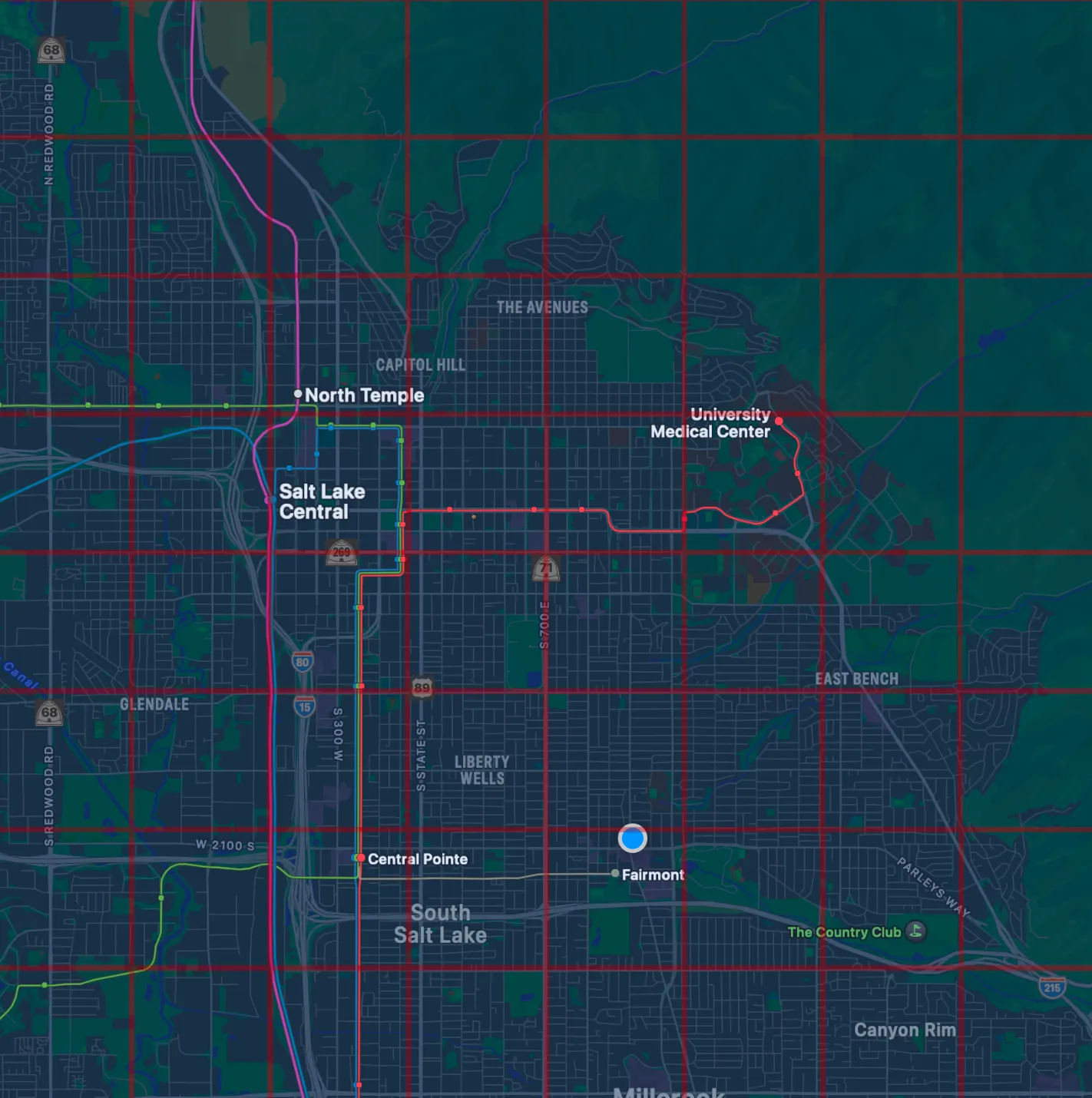
(Not only is this a demonstration of the scale, but is also a demonstration of how small the metro area of Salt Lake City is.)
Obviously, though, they’re not talking about making the cities in this composition — they’re talking about the outer rims of metro areas, anywhere within a reasonably short area to, say, run errands.
My benchmark for “how far am I willing to drive in order to get errands” has laid at many places over the years. In my high school years, I lived in Spring Creek, Nevada, where getting groceries was a 20 minute drive over 12 miles, one-way. Now, it’s about a 5-minute drive over a half-mile.
Performing the same analysis on the Elko-Spring Creek relationship — very much a Small Town-Rural relationship, based on the population counts from 01-independent-regions:
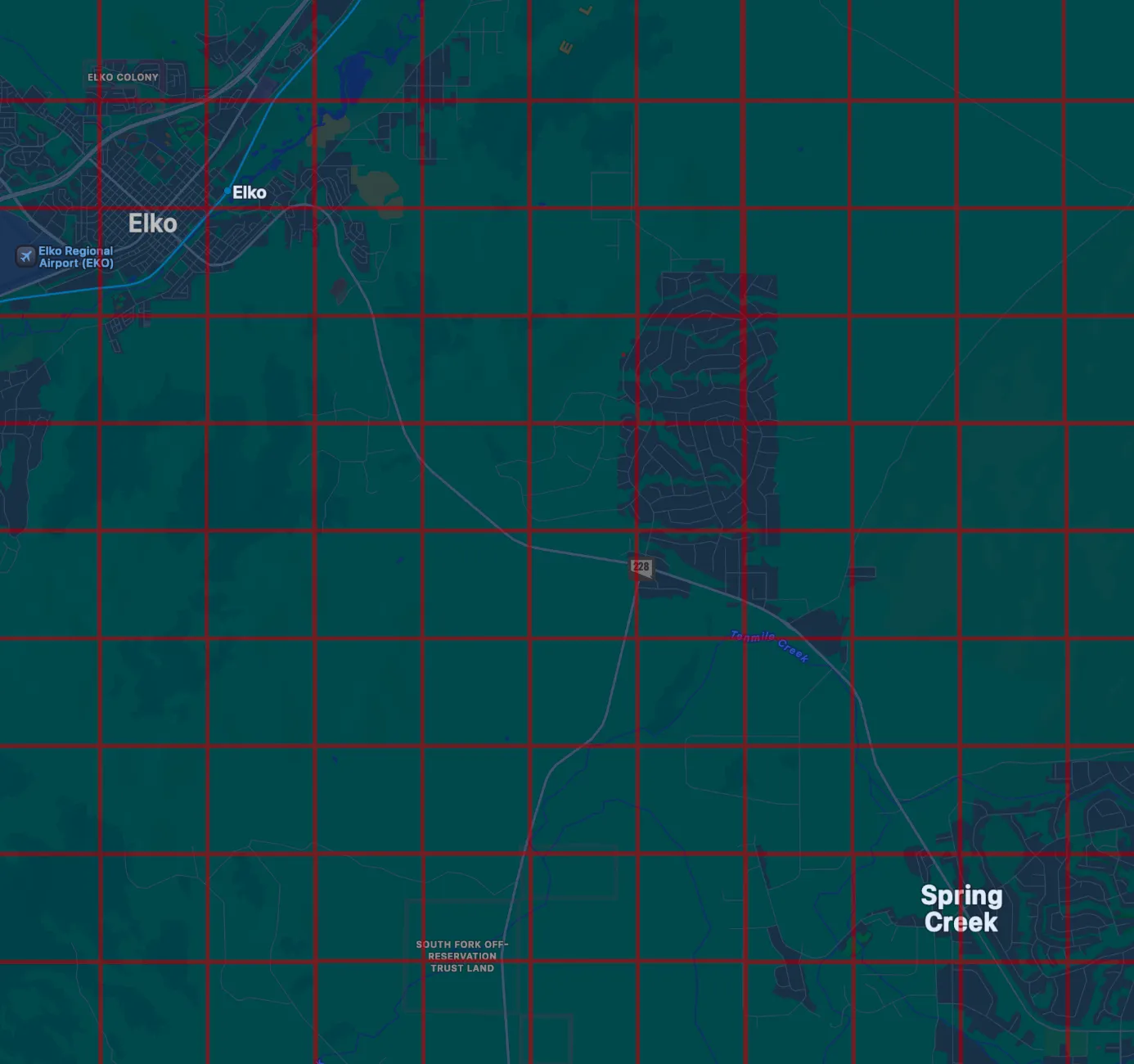
Even here, we see that a 1 square-mile setup is wildly sparse, with even modern rural areas not quite hitting that level of low-density. As a mild spoiler for 06-country-towns, and borrowing from the policy argument made in 02-the-distribution-of-towns about city economies facilitating redistribution to fund necessary rural infrastructure that would be considered inefficient in a free market, this level of density, in this era, necessarily requires external policy support if it is to be preserved in scenarios where a nearby city’s growth and development (can you see how I’m dancing around the word sprawl?) begins to encroach on yet-preserved surrounding areas.
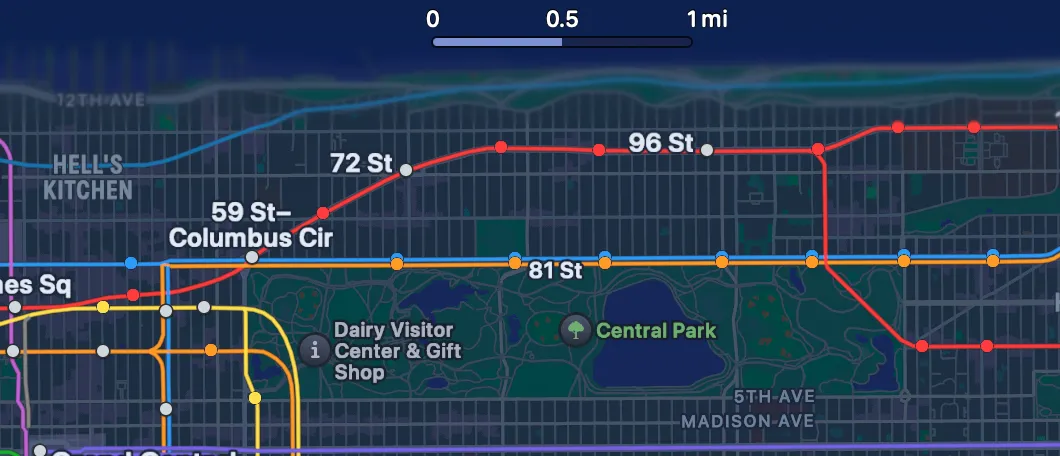
A good example of how public policy can push to preserve these types of spaces is Central Park, in New York City. A free market for development certainly wouldn’t have been able to coordinate a pocket of nature in the middle of one of the busiest cities in the world — that bubble of green in a sea of developed land is sustained by the pressure of policy, not market structures.